Tuesday, April 25, 2017

We've Been Busy!

We have had so many great learning engagements lately, that it's hard to keep up! Here are a few highlights:

Visiting Author David Greenberg 

We had the amazing opportunity to learn from author David Greenberg last week. Mr. Greenberg has written many books, mostly consisting of poetry. We had our own special kindergarten session full of giggles and smiles.


Some of us also attended a special after school session that Mr. Greenberg offered for families. Once again, smiles and laughter filled the room.


Mr. Greenberg inspired us to become published authors ourselves and we are motivated to continue writing and sharing our ideas.

Unit of Inquiry:

We have also had many special guests visit kindergarten to address various aspects of our unit of inquiry on fabric.

Amira's mom taught us all the ins and outs of making clothes: 

Ricky's mom taught us about Chinese clothing:

Chinonso's mom and friend introduced us to Nigerian clothes:

Ms. Monday talked all about Tanzanian clothing:

Aimee's mother showed us what Dutch clothing looks like:


Eliab's mother came and share Ethiopian clothing with us:

Ms. Sonja from EC3 taught us all about knitting:


And Morgan's mother introduced us to the sewing machine:


Through all this wonderful sharing we have been exposed to so many ideas regarding fabric and its various uses. We have learned a lot about cultural and environmental influences on fabric. Additionally, we have done a number of experiments in class to explore the properties and design of fabric. With the information we discovered, we have been able to predict different places fabrics are used.

We explored the words "waterproof" and "absorb":


'Breathability':

'Woven' & 'Knitted' Fabrics:


'Transparency':


'Dying':


.... and so many others that it's too many to post!!

Lastly, one of the best parts of this exploration has been the action individual students have taken to discover and expand their understanding even more. Our classroom has been a flurry of activity each afternoon involving sewing, learning to knit, and making clothes for babies and toys. 


We can't wait to show off our learning during Friday's Expo and Fashion Show!

Thursday, April 13, 2017

Sabahar

We have had some really engaging learning experiences pertaining to our current unit of inquiry lately. I will talk about more of them in a later post, but first I want to highlight one that was a bit hit.


We had the wonderful opportunity of going to Sabahar this week. Sabahar is a company that makes handmade Ethiopian textiles. These textiles are handmade with natural fibers, including cotton and silk. You can learn more about Sabahar by clicking here.


Our field trip began with a great presentation focused on different fabrics. Sophie, from Sabahar, showed us examples of clothing made from cotton, wool, leather, silk, and polymers (oil & plastic). This gave us a bit more background on the variety of sources from which fabrics are made, and helped us to think a bit more about what makes each fabric source unique. 


We then had the opportunity to help weavers in their work to produce scarves, rugs and table runners. In class we had learned about the warp and woof involved in weaving, and we even tried weaving ourselves on small cardboard squares, but our field trip provided the opportunity to help make a real product! We also helped spin thread and learned that traditionally in Ethiopia, woman do the spinning while men do the weaving.


After spending some time in the weaving and spinning room, we were taken outside where we learned more about the dying process. It was amazing to find out that the colors on our clothes come from natural sources such as coffee, cactus buds, flowers, and even onion skins.


We were each given a square of fabric and had the opportunity to dye our fabric.


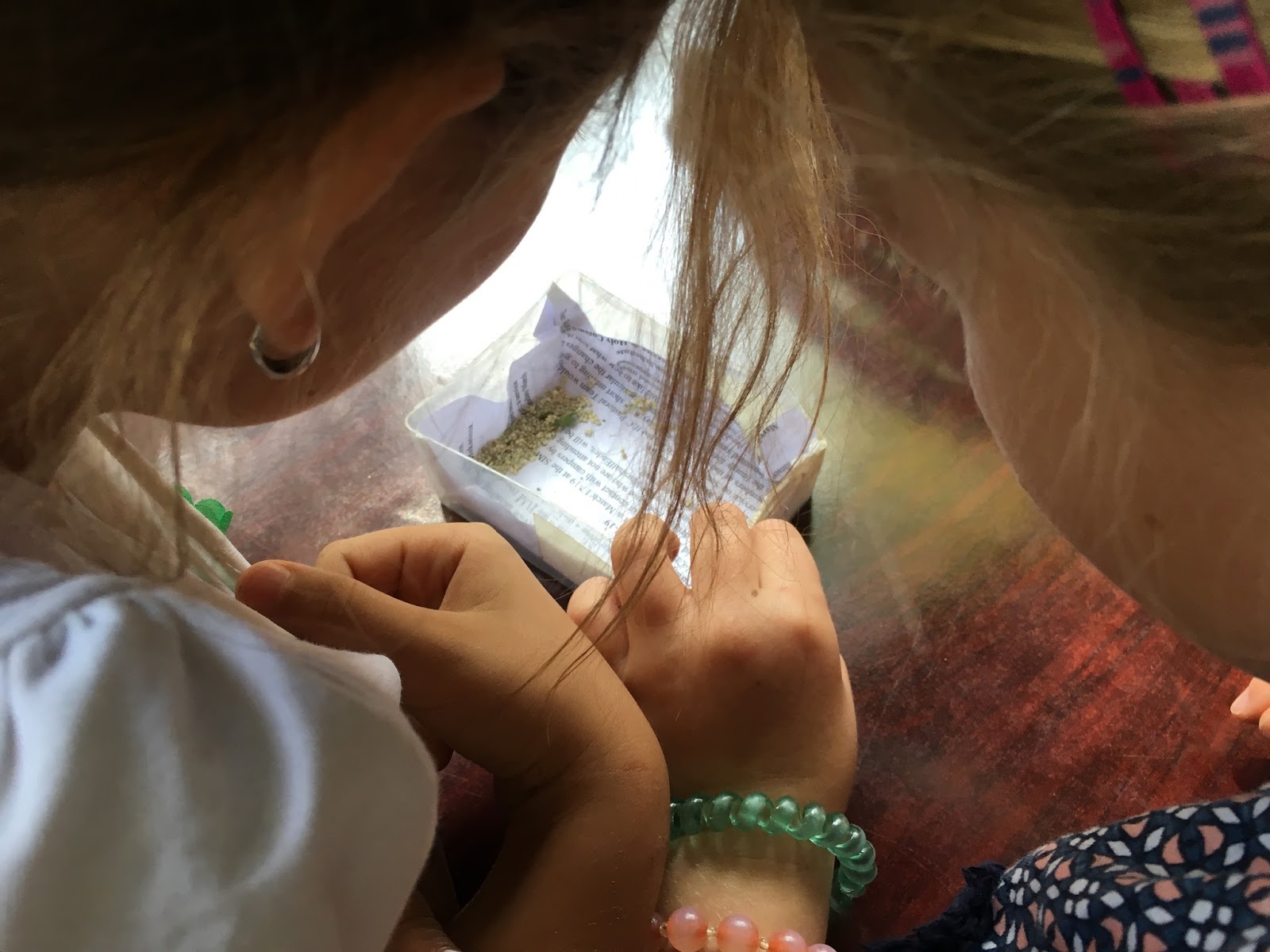
Next, we learned how silk is made. We learned about the life cycle of a silk worm, beginning with the egg:


Giggles and squeals then filled the air as we had the opportunity to hold silkworms (which we learned are actually caterpillars). Many of us were a bit scared, but we decided to be courageous and of course were so glad we were! We found the silkworms to be sticky and learned that they stick to the bottom of leaves to protect themselves from predators.


Sophie told us how the silkworms eat leaves for nearly 45 days, getting bigger and bigger until they are ready to metamorphoses. To do so, they produce silk that comes out from their bottom lip, which they then spin around themselves until they are completely covered. They stay in their cocoons for two weeks before emerging as moths.


The silk we use to make fabric comes from the cocoons, which are boiled and then unwound. It was interesting to learn that while silk seems like it would be very delicate, silk threads are actually very strong! 

We ended our visit by comparing silk to cotton, and even had a chance to examine the two together. 


We have already taken so much of what we have learned from our field trip to Sabahar and applied it to our classroom learning. I captured some wonderful photos of this experience, so please do take the time to click on this link and view more of our photos.


Tuesday, April 4, 2017

How Many Sides Does a Circle Have?

Last week during our initial revisit to shapes, we experimented using modeling clay, straws and sticks to make shapes. We then were introduced to drawing these shapes using rulers to make straight lines.


Within this study, one student drew a circle with two dots (representing corners). She had forgotten that we were only drawing shapes that we could use our ruler for to draw straight sides. This 'mistake', however, led to some great inquiry.


As we examined each other's shapes, some students pointed out that the circle did not have any sides because they weren't made using a ruler, and therefore weren't straight. Other students thought that it had two sides, as represented in the original drawing. Still another small group argued that a circle has four sides and the drawing should actually have been made with four dots (top, bottom, left and right). So we were at a stand-still. How many sides does a circle actually have?


The next day, we decided to inquire into this a bit further. With pins representing the corners (or modeling clay as used in the previous lesson), and yarn representing the sides, we set to work taking on different challenges. The first challenge was to work in teams to use the pins and yarn to make a triangle. With our fairly sound knowledge of the properties of triangles, this was fairly easy.


Next we were challenged to make a rectangle. We know that squares are a special kind of rectangle, so we determined squares were also acceptable. This was a bit more challenging as we realized that the placement of the pins (corners) had to be more precise in order to make the sides be "straight up and down or straight side to side" (parallel). 


 And finally, our last challenge was to use our pins and string to make a circle. This was tricky and we really had to use cooperation to get it just right.


We stood back and looked at each group's 'circles'. Some of them looked a lot more like circles than others. What made this so? We spent the day thinking about this and then revisited pictures of our creations the following day. Each group's 'circle' was displayed and we had to determine of these we thought most closely resembled a circle. We moved throughout the room and clustered into groups to show our thinking. We then worked within that small group to discuss why we thought the way we did. What made us choose the shape that we did? We followed this by defending our ideas against other groups.


 These were our collective group thoughts:

Created with flickr slideshow.


After we had a chance to listen to each group argue, we had one more opportunity to change places. This ended up with the class almost equally divided amongst two circles -- the green and red.


So what made these two shapes resemble circles more closely than the others? We determined that the more pins used, the more circular the shape. And so, we came to (well, just about) what we think may be the answer :

A circle has an infinite number of sides.

(And now if we could just grasp at the word "infinite"! This will be explored more a bit later in school. ;) )


Wednesday, March 29, 2017

EC3 Reading Buddies


Today we had the wonderful opportunity of meeting up with EC3B. We read our just-right books to them and felt proud to share our reading with others. Ask your child to tell you about it!

Monday, March 27, 2017

New Unit of Inquiry

Last week we began our new unit of inquiry, which focuses on fabric. We will be examining many different aspects of fabric, and will also be inquiring into other areas of study within other subject areas. Please take a moment to read through the newsletter below as it will provide more detailed information as to where we are headed:


To begin this unit, we closely examined photos of various people around the world. We shared our thinking about what and why specific people were wearing certain clothes. Were they doing something special? Was the person in a location that might require that clothing?  We shared our thoughts with one another and built off each others' thinking, which was recorded in scripted form.

To allow us to demonstrate our initial individual understanding of this unit, we then were each given a photo and asked to elaborate on the clothing we saw the person wearing. We used the app ThingLink to capture our thoughts. Take a look at one example:


The information gathered through these engagements will help determine what prior knowledge we already have and where we need to start.

We then explored six different types of fabric. We worked in partnerships to describe the fabrics and think about where we might have seen these fabrics being used. This was followed by a 'fabric hunt' around the school. Our goal was to find the various fabrics and who was using each and why. (See more photos from our fabric hunt by clicking here.)


The next day, we returned to these recording sheets and photos of ourselves exploring fabrics throughout school. We spent time recording the properties of each fabric and what important job each fabric was doing in each photo taken of our fabric hunt. We found patterns (such as many of them were used to protect people from various things) and also noticed that the fabrics seemed to have been chosen to fill a specific need.


KG-B is looking forward to continuing to explore fabrics and their many uses. As noted in the newsletter posted above, please do let us know if you would be willing to come in and share how you use fabric -- either as a hobby, for work or cultural reasons. 

Friday, March 10, 2017

Math Workshop

Our math workshop time the past several weeks has focused on combining and separating numbers. We have worked quite extensively with number bonds, which has helped us solidify our understanding of what it means to add.


Throughout this unit on addition and subtraction, we have incorporated whole-body kinesthetics to physically add and remove ourselves to different groups, and we have also used manipulatives to play around with sets of numbers.

During the "practice" portion of math workshop we often engage in games and hands-on activities. We learned three new games this week. Ask your child to tell you about them, and maybe even find some games to play at home! Click here to see some ideas that involve only a deck of cards and are fun for the whole family.